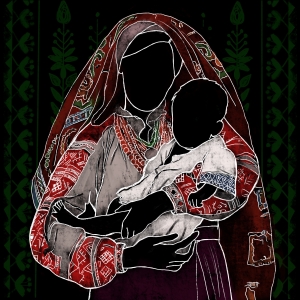
“Mothers did not know where they would spend the night with their children”: a new reimagining of the Ukrainian lullaby, Kolyskova, “The dream passes by the windows”. Until this year of 2022, the words of this lullaby have always been associated with the warmth of a mother, the comfort of one’s home, and a soft bed. This is a song that every Ukrainian knows on a genetic level. However, with the commencement of Russia’s full-scale offensive on Ukrainian territory, this lullaby came to be perceived somewhat differently.
“On the day that Russia had commenced its full-scale offensive on our country, I was in Brazil. I could not think of much else to do, so I started helping my friends and relatives evacuate. I didn’t sleep with them, as I endured kilometer-long queues at the border, looked for places for them to spend the night, and checked road safety and air raid alerts. Each day started with dozens of “are you alive?” messages.” says Valya.
Although there are many variations of this lullaby, each differing in its melody and imagery depending on the region, they all have one part in common:
“The Dream asks Sleep,
Where shall we spend the night?
Wherever there is a warm little house
Where inside lives a little child
That is where we will spend the night
And surround this child with love.”
Deeply touched by conversations with mothers who had to flee Ukraine, Valya conceived the lullaby “Oi Khodyt’ Con Kolo Vikon” (“The dream passes by the windows.”) in a new way.
“In the lullaby, the Dream asks Sleep where they will spend the night. Sleep answers: wherever there is a warm little house. As I was singing this part to myself, I realized that because of the war, thousands of our mothers did not know where they would spend the night with their children. Each one of them dreamed of a “warm little house,” but they wound up having to sleep wherever they were lucky: maybe in a car at the border, or in crowded trains, and even under shelling in Azovstal.” says Valya.
The song was recorded in Brazil together with local musicians who deeply felt the meaning of this lullaby. It was co-produced by Kiko Woiski and Valya herself, mixed by Latin Grammy award- winning engineer, Adonias Souza Jr. The significant cover art was done by Kateryna Zhovta. Levchenko has also concept and managed the images production for the music video for the past 3 months, which was directed by fellow Alexey Taranenko.
“I aimed to show the faces of women who had to flee. They each sent me their personal stories, all of which drove me to tears and gave me goosebumps. I didn’t want these women to simply be reduced to abstract depictions of faceless refugees in this world, so in the clip you will see them with their children along with their lived experiences,” concludes Valya.